


Grain piles often have gaps, and different grains have different porosities, which leads to certain differences in the resistance of different grain layers per unit. The flow and distribution of gas in the grain pile are affected, resulting in differences. Research on the diffusion and distribution of sulfuryl fluoride in different grains provides support for guiding storage enterprises to use sulfuryl fluoride fumigation to develop better and more reasonable plans, improve the effect of fumigation operations, reduce the use of chemicals, and meet the environmental protection, economic, hygienic and effective principles of grain storage.
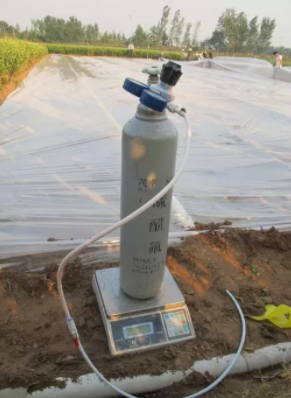
According to relevant data, experiments in southern and northern grain warehouses showed that 5-6 hours after sulfuryl fluoride fumigation on the surface of wheat grain piles, the gas had reached the bottom of the grain pile, and 48.5 hours later, the concentration uniformity reached 0.61; 5.5 hours after rice fumigation, no gas was detected at the bottom, 30 hours after fumigation, a large concentration was detected at the bottom, and 35 hours later, the concentration uniformity reached 0.6; 8 hours after soybean fumigation, the gas concentration at the bottom of the grain pile was basically the same as the concentration on the surface of the grain pile, and the gas concentration uniformity in the whole warehouse was good, reaching above 0.9.
Therefore, the diffusion rate of sulfuryl fluoride gas in different grains is soybeans>rice>wheat
How does sulfuryl fluoride gas decay in wheat, rice, and soybean grain piles? According to tests in grain depots in the south and north, the average sulfuryl fluoride gas concentration half-life of wheat grain piles is 54 hours; the average half-life of rice is 47 hours, and the average half-life of soybeans is 82.5 hours.
The half-life rate is soybean>wheat>rice
The decrease in gas concentration in the grain pile is not only related to the air tightness of the warehouse, but also to the adsorption of gas by different grain varieties. It has been reported that sulfuryl fluoride adsorption is related to grain temperature and moisture content, and increases with the increase of temperature and moisture.
Post time: Jul-17-2025


